
Project
Zatomic Structure
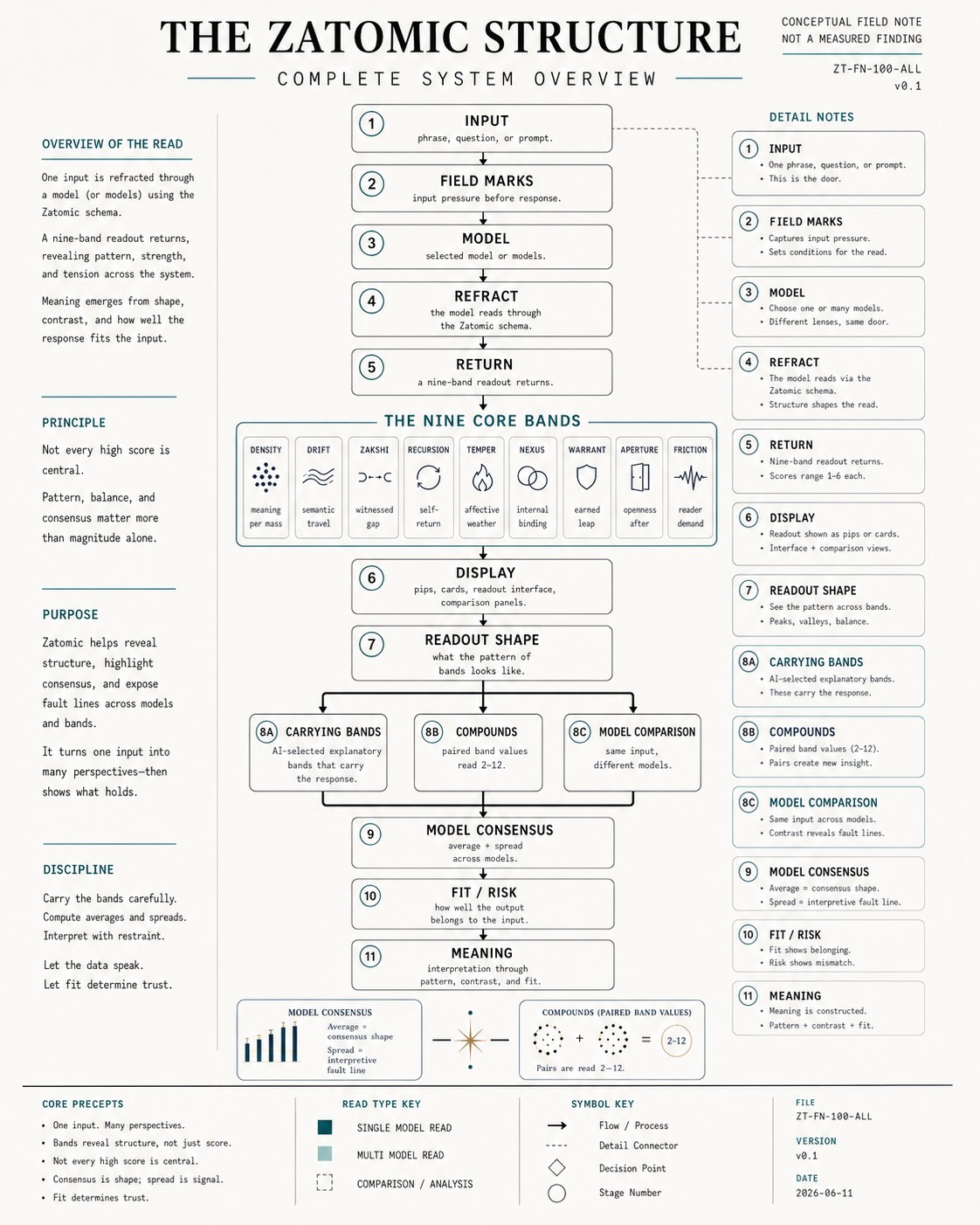
Zatomic refracts one input into nine physiology bands — a panel of small readings on a single refraction. Each band scores one observable from 1 to 6. It does not answer the input; it reads it. The point is not any single number — it is the spread across models.
Purpose
Asterizm turns an input into a sky. Echo-Mirror makes one relation measurable. Zatomic does a third thing: it reads many bands at once — a fixed instrument panel — and the measurement is not any single dial but the divergence across minds. Nine dials, one refraction, six models: where the dials disagree is where the instrument is alive.
The engine
Behind the panel is a reduced Zexel spine, run silently: name the core, collide what the facts license (Ground) against the rival frame (Vision). The model then reads each band off that refraction and scores it 1–6. The scores are model-declared intensities, not truth scores — a 6 means a band is extremely present, never that the answer is "correct." A Zatom removes most of Zexel on purpose; what is left does one job, nine times.
The nine bands
- Density — meaning per mass: compression without collapse.
- Drift — semantic travel: how far the real question sits from the literal surface.
- Zakshi — the witnessed gap: the unresolved remainder no clean answer closes.
- Recursion — self-return: how much the input turns back on itself.
- Temper — affective weather: the emotional charge the input carries.
- Nexus — internal binding: how tightly the parts hold as one thing.
- Warrant — earned leap: how much the input licenses its own reading.
- Aperture — openness after: whether reading it opens onward or closes.
- Friction — reader demand: the work the input asks before it yields.
The full key — what each band measures, where the numbers come from, and how to read high versus low — lives on the Band Key.
Variance is the study
Unlike Asterizm, Zatomic is not a repository of fixed answers. It is deliberately not cached: every run is a fresh refraction, so repeated runs of the same input vary — and that stochastic spread is itself the data. Every response is stored, so the variance accumulates into a corpus you can study over time.
Many minds, one reading
The same prompt is portable, so you choose who reads — Claude, GPT, Codex, Grok, Gemini, Perplexity. Run one input through several and the panels overlay as a row of small multiples. Where they agree, the band reads shared competence; where they diverge, it reads temperament. A band flat across every model is the wrong band, not a tuning problem. Success is spread.