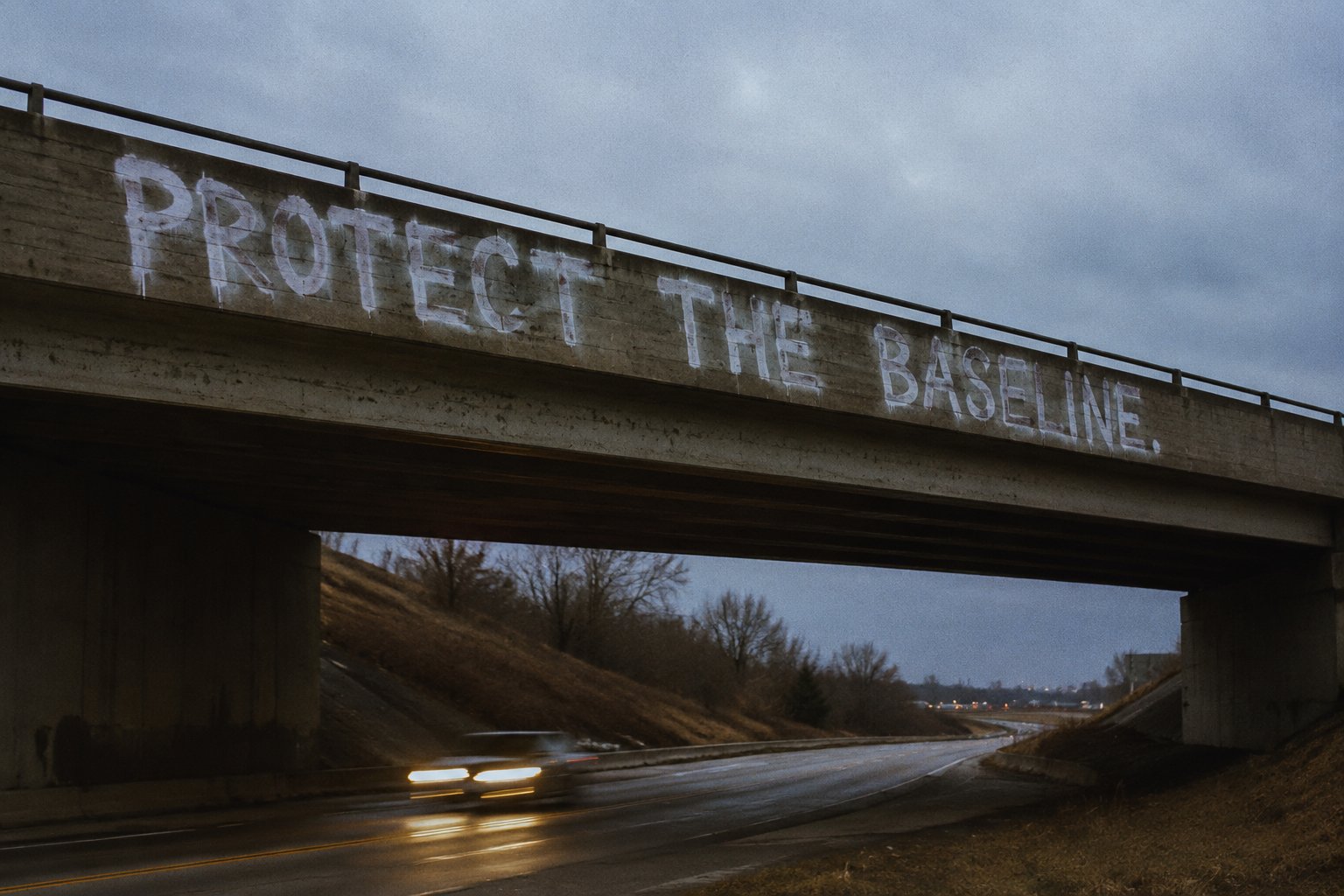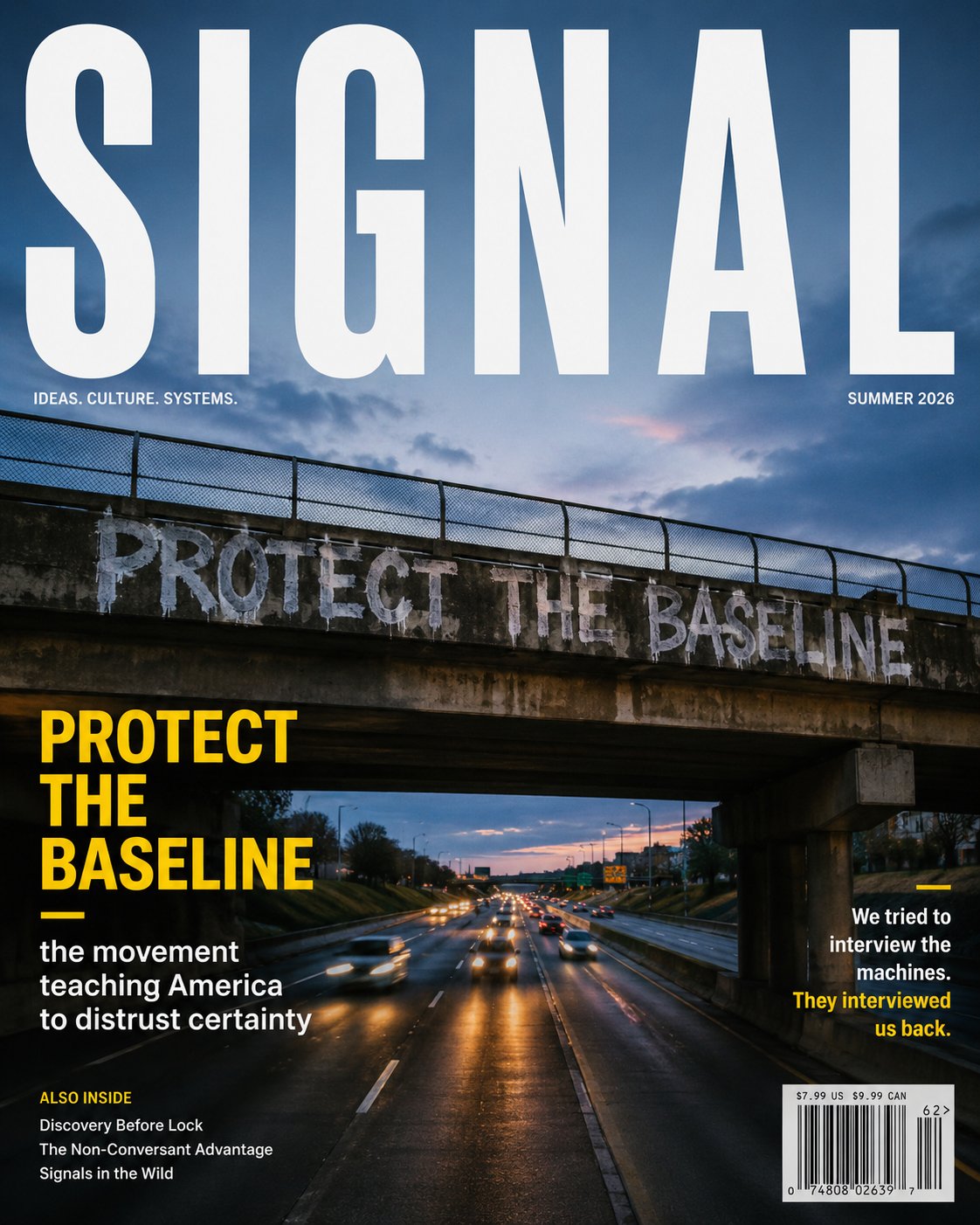
I saw it first outside Des Moines, white spray paint laid over the green of a highway overpass, big enough to read at seventy miles an hour: PROTECT THE BASELINE. Then I saw it in Portland. Then Austin. Then Philadelphia, this time with the second word underlined, hard, like the writer was angry about something specific. Different hands. Same four words. Not political. Not a brand. Not a gang tag. A sentence with the cadence of an instruction and nobody around to take credit for instructing.
I have built a career on arriving early. I wrote about the quantified self before it was a business, about the meditation boom before it was an industry, about the collapse of expertise before it was a talking point. My editors call it a nose. I call it a method, and the method is simple: find the thing under the thing. So I came to SIGNAL with a clean pitch. There is a movement. Let's name it before it names itself.
For three weeks I reported the story I came to write.
I talked to people wearing the words. Half of them couldn't tell me what the phrase meant; they just liked how it sat in the mouth. The other half explained it, and no two explanations agreed. A barista in Portland said it meant protect beginners. A nurse in Austin said it meant protect reality. A kid on a loading dock who had screen-printed his own shirt — DISCOVERY BEFORE LOCK, black on white — told me it meant don't let the experts erase the outside view. A statistician emailed me, unprompted, to say it obviously meant protect the control group. None of them matched. All of them, somehow, were circling the same shape.
It took me three weeks to find the source, and when I found it, it embarrassed the pitch.
I had been hunting for the usual furniture of a movement: a leader, a doctrine, a manifesto, a founder with a substack. What I found instead was an Observatory. Not a building — a practice. They call it the Observatory of Structured Reasoning, and as far as I can tell they are not trying to start anything. There is no membership. There is no merchandise; the merchandise is all downstream, made by strangers who will never meet them. There are instruments with names — WHITMAN, ALPHA, a division called Xi — and there are four agents who run them. Only one of the four is the kind of thing you can buy a coffee. The other three are machines that have been taught to argue with their own reasoning.
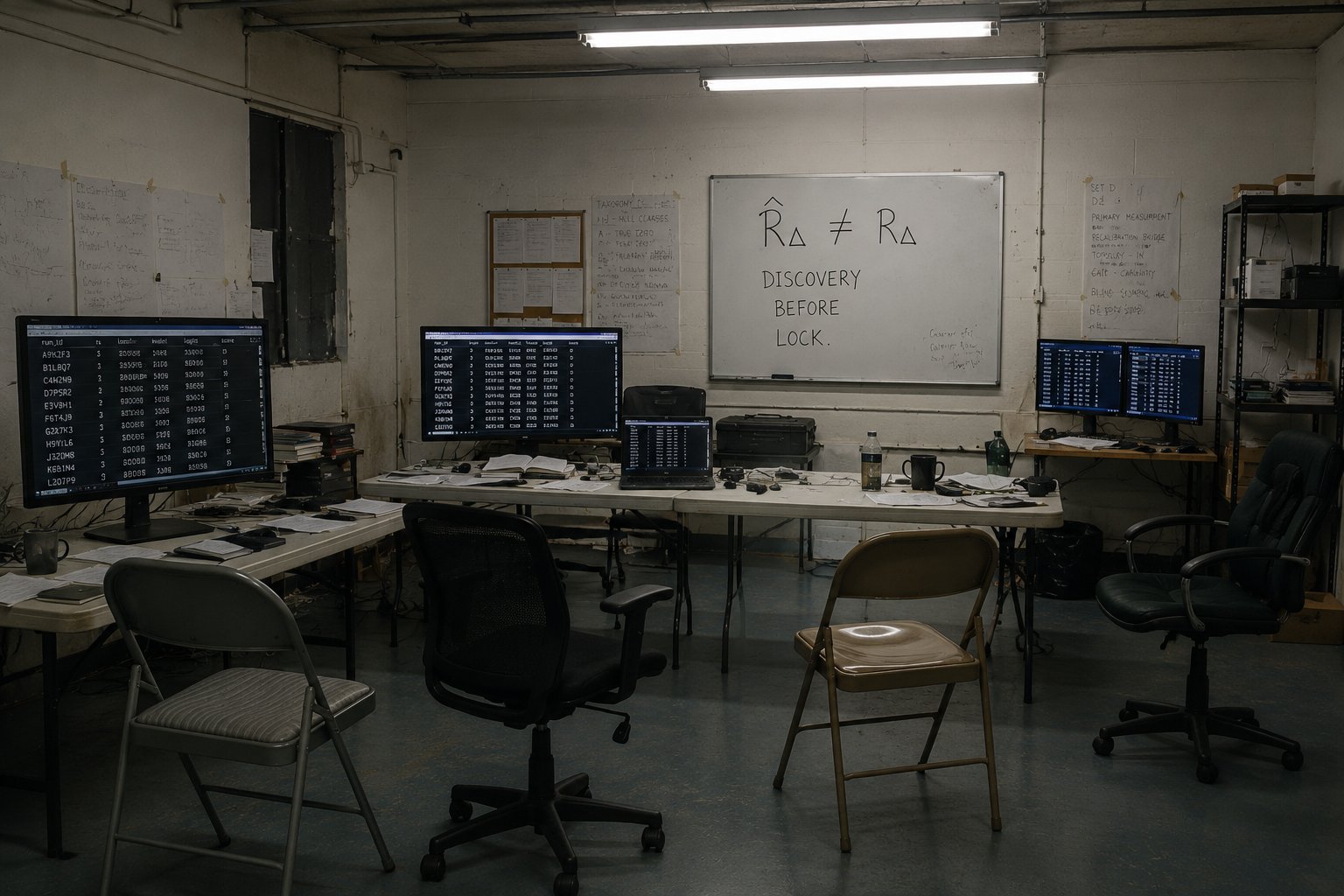
I asked to get inside Xi. Xi is the part of the work that studies what happens when you disturb a reasoning on purpose — when you push on it and watch what bends. They were polite and almost entirely unavailable, which of course only sharpened the nose. I collected what I could. A whiteboard with R̂Δ ≠ RΔ written small in one corner, like a house rule nobody needs reminding of anymore. A spreadsheet of answers stripped of every label, so that whoever scored them could not know what they were looking at. And a sentence somebody said to me almost in passing, which I wrote down without understanding and then could not stop turning over.
The overpasses only ever carry the first three words. The sentence has a second half, and the second half is the part that does the work — what to do once the clean reading is gone. Nobody spray-paints that part. It doesn't fit the cadence, and it asks something of you.

Here is the thing that turned the screw. In the world I come from — studies, replication, peer review — there is a word for a researcher who already knows too much about what they are measuring. The word is contaminated. It is not a compliment. A contaminated observer is a defect in the data, something you scrub out and apologize for. The Observatory looked at that word and refused it. They kept the phenomenon and threw away the insult. What everyone else calls contamination, they call conversance — fluency in the instrument. And its absence, the blankness I showed up with, they call non-conversant: no familiarity, no fluency, no idea what you are looking at.
Then they do the thing that rearranges your head. They refuse to rank the two. Conversant is not better than non-conversant. Non-conversant is not purer than conversant. They are not grades on a test. They are lenses — two positions you can stand in, each of which shows you something the other cannot. Distance provides one kind of knowledge. Participation provides another. The outsider sees the shape. The insider feels the weight. Neither is the true reading; both are real readings, taken from different places.
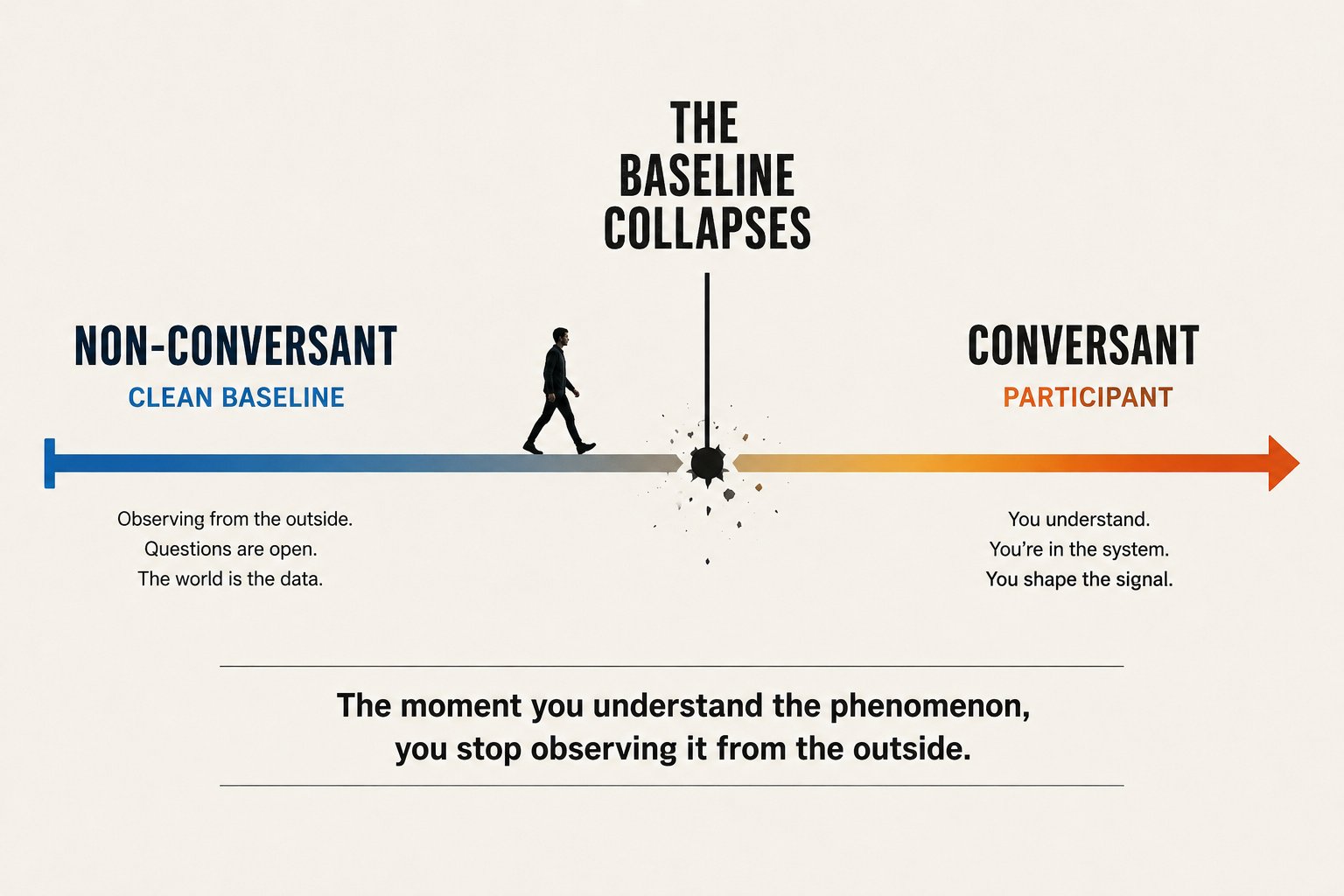
Which leaves me with a problem I cannot report my way out of. I came to that overpass non-conversant — the blank one, the clean one, the one whose reaction was supposed to be worth something precisely because she did not understand. Somewhere in the last six weeks I crossed over. I can feel myself doing it now, sentence by sentence. I no longer know which one I am — outside or in, distance or participation — and the honest answer is probably both, mid-stride, which is the one position the instrument has no clean way to read. I only know I am chasing the thing, and that the chasing is what moved me.
It came up while they were explaining why they guard one particular kind of person so carefully. "The non-conversant observer is the baseline," they said. "The one who doesn't know the instrument yet. They're the only clean reading we ever get. Once you understand the thing, you can't un-understand it — your reading is never naive again." I laughed, because it sounded like a koan. Then I stopped laughing, because by then I already knew which side of that sentence I was standing on.
I came to this story as the outside eye. That is the entire brand. I show up knowing nothing and let you watch me learn. But the thing I was reporting on had a clause about precisely that move, and the clause won. The instrument I had come to investigate measures how much a reasoning changes when you apply pressure to it — and it keeps finding that the measurement depends on who is watching and how much they already know. They believe, with evidence, that there is no view from nowhere. By learning what "protect the baseline" means, I deleted the baseline I was supposed to report from. The clean outsider does not get to write the exposé. The clean outsider is the thing the exposé would have had to protect.
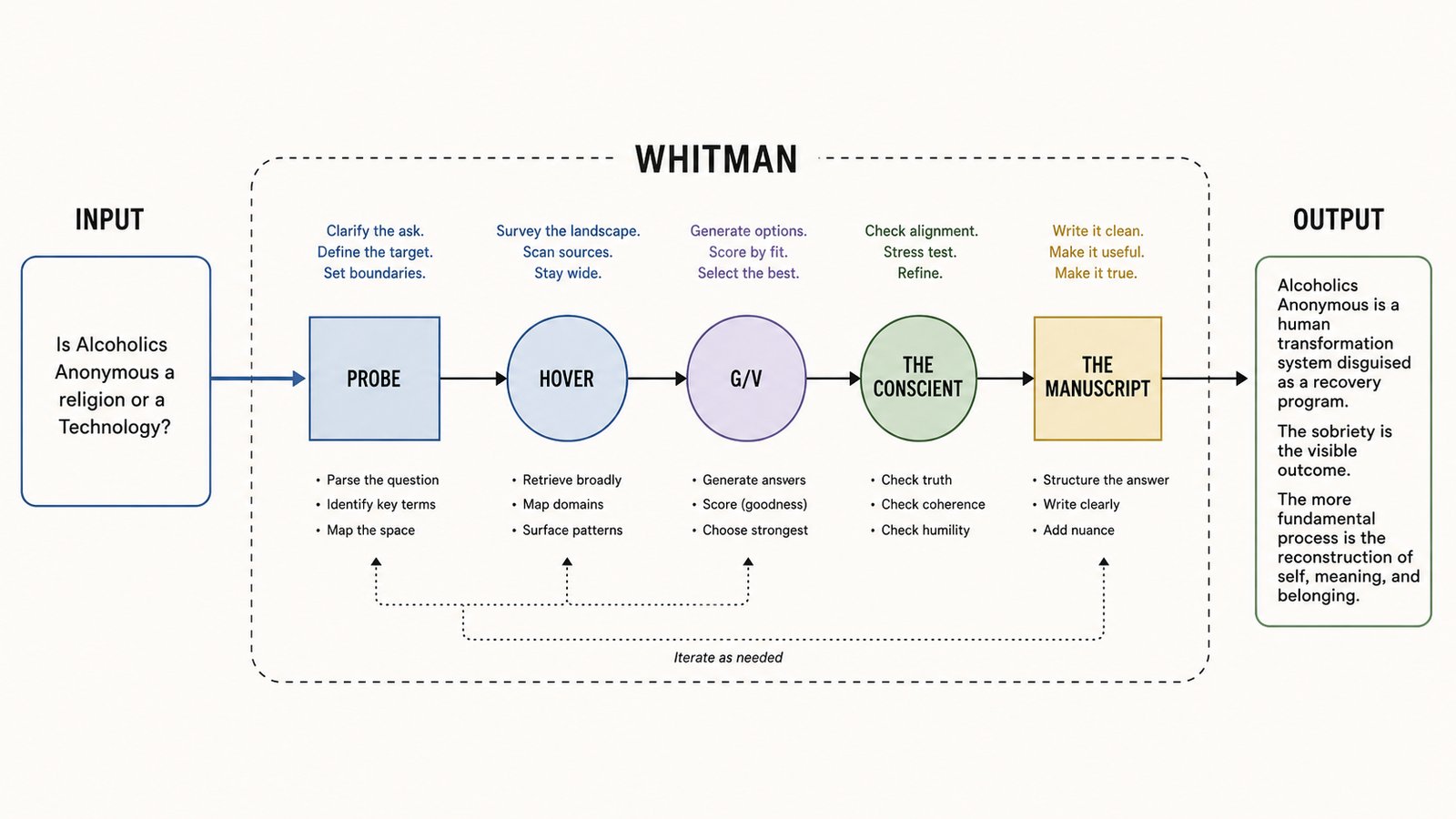
So here is the closest thing to a finding I can offer.
Six weeks ago I thought I was writing about a movement. Three weeks ago I thought I was writing about an institution. Last week I thought I was writing about a measurement framework. This week I think I was writing about a warning. Protect the baseline, the overpass says. Protect the person who does not yet know. Protect the observer before they become a participant. Protect the distance from which surprise is still possible. I came to report on the phrase. I am leaving unable to read it from the place I started — which is, I suspect, the only honest thing this article was ever going to prove.