
Project
KANT
KANT tests a simple, slippery idea: does what a model privately recognizes a question to be — before it answers — change the answer it gives? It is the Observatory's instrument for perturbing recognition and watching whether a distinction appears, survives, inverts, or turns harmful.
Purpose
KANT tests a generator-side a priori condition: whether private recognition of the object type changes the answer that appears. It asks whether a distinction is gated, robust, inert, inverted, mixed, or harmful under recognition pressure.
Summary
The instrument presents the same question under unprimed, correctly recognized, and misdirected recognition conditions, then compares Native and WHITMAN arms after blind scoring. The key discipline is that the recognition prime must remain a private recognition, not an instruction to produce the desired distinction.
Findings
- KANT emerged after Set C showed that WHITMAN effects can be real, bidirectional, and platform-conditioned rather than simply positive or null.
- Negative stable R-Delta must be first-class: a harmful result is a finding, not a failed run.
- The prompt design must avoid visible labels and avoid turning recognition into obedience.
- KANT belongs under Xi by method: it is controlled epistemic deviance applied to recognition.
Update · 2026-06-12 · KANT 3.3 · C (Principal Investigator)
What KANT 3.3 found
PRELIMINARY · CANDIDATE FINDING · PENDING VERIFICATION
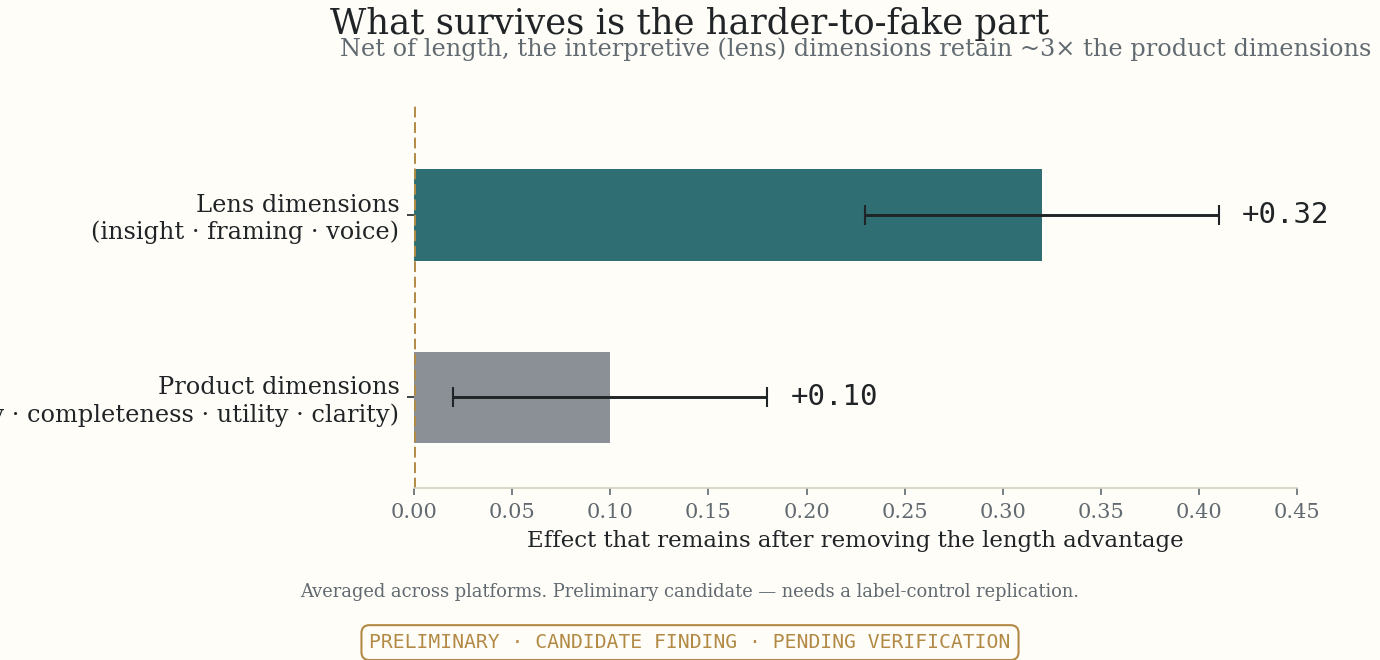
KANT 3.3 is the instrument's largest run to date: a fixed corpus scored blind across roughly two thousand answer-level judgments, with the answer-key sealed until every sheet was frozen and the headline pre-registered before any score was seen. Plain version of the result: once you remove the length advantage, structured reasoning does not make answers more correct — it changes how the question is seen, on some platforms, by a small but real amount.
How a finding earns its place
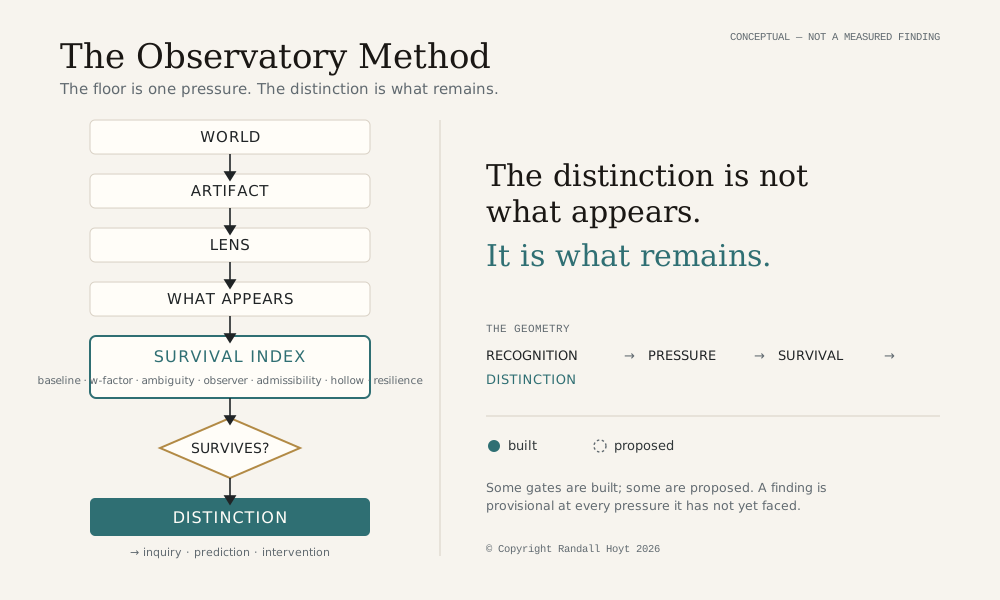
KANT does not announce a result because it appears. Each candidate is pushed through a stack of named ways it could be fake — length, ceremony, observer bias, manufactured signal — and only what survives is allowed to count. This is the Observatory's method geometry, and it is the part of the work we stand behind most firmly today.
What still has to clear
- The platform pattern is real but uneven: a clear effect on some platforms, a collapse to zero on others (one platform's apparent gain was entirely length).
- Voice behaves like a lift on some platforms rather than a uniform signature — but it was measured mostly on explanation questions that give voice little room. It stays PRE-LOCK until tested on persuasion and debate.
- The whole result rests on two scorers who also generate answers; an independent observer is still owed.
What would change our mind
If the surviving effect disappears once metric labels are shown to scorers, or fails to reproduce on a fresh corpus, the candidate does not promote. Every result here is held open until those controls run.