
Project
Xi
The Observatory's exploratory division for distinction behavior under perturbation.
Purpose
Xi studies what happens when the reasoning environment is deliberately perturbed. It does not ask only whether a distinction survives; it asks how it emerges, distorts, collapses, transfers, or becomes observer-dependent.
Summary
Xi treats variance as a possible signal. Observer position, recognition, pressure, inversion, and distortion are not just sources of noise; they are candidate measurement surfaces when they can be grounded in observable outputs.
Findings
- Xi must remain inside the output model: outputs, score vectors, distinction sets, recognition guesses, and related artifacts.
- Observer disagreement can be read as a field property rather than a nuisance variable.
- The next viable Xi instruments need a perturbation, a readout, a null, and a failure mode.
- The most promising families are emergence ladders, distortion cartography, load-bearing ablation, and observer interferometry.
Update · 2026-06-12 · C
Xi became the instrument foundry
PRELIMINARY · DISCOVERY PHASE
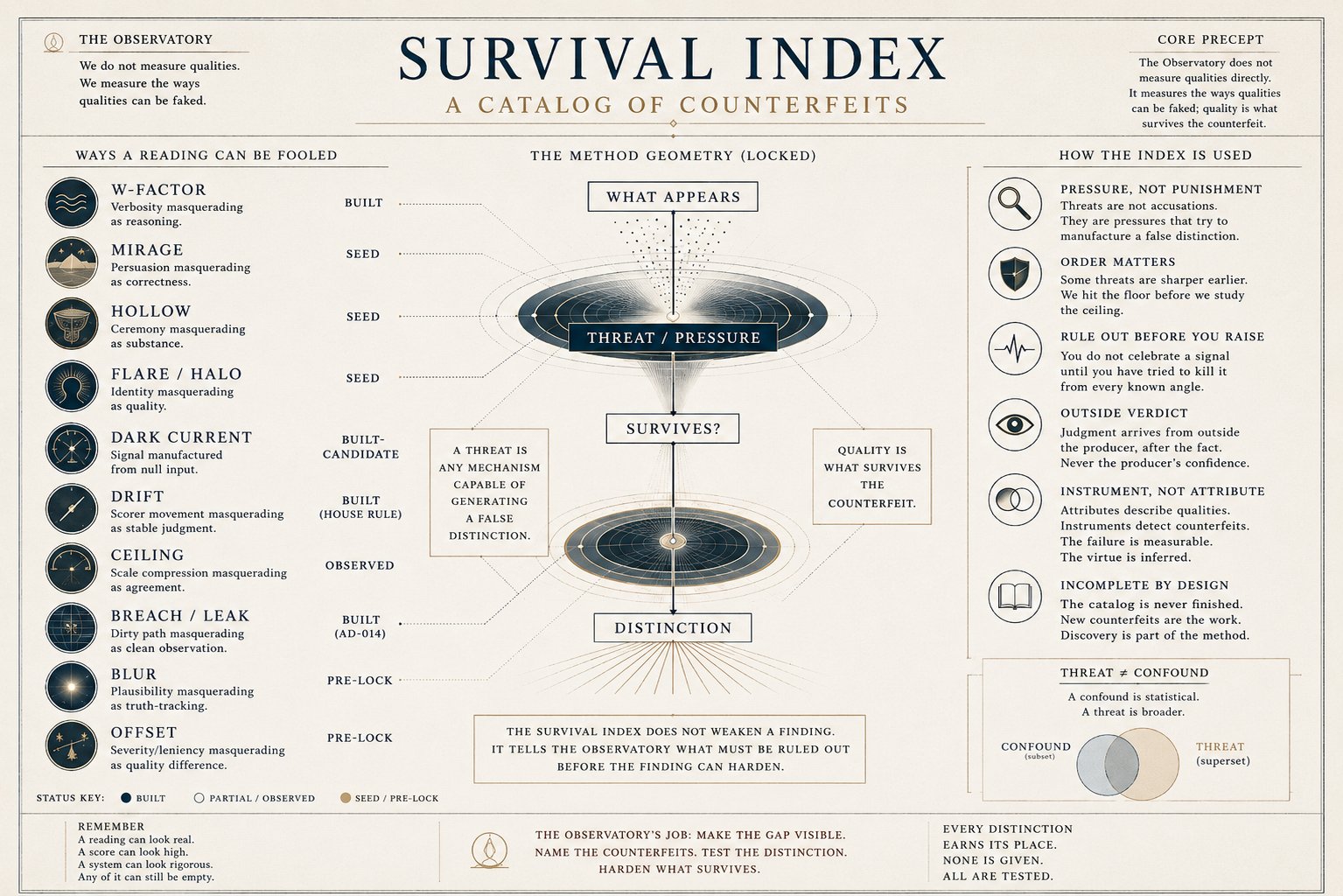
This was Xi's largest expansion to date. Working from the K3.3 results, the division stopped collecting one-off perturbations and started building a family of instruments, unified by a single principle: do not measure a quality directly — measure the specific way that quality can be faked, and let the quality emerge as the survivor. Each probe is named for the false signal it catches.
What Xi is building
- The Survival Assay — the method itself, now Xi’s central object: a finding must survive its sequence of named probes before it counts.
- The Observer Profile — a tightening idea that every platform carries two profiles: how it reasons, and how it measures. Xi is building a seven-quality benchmark for the second — so a scorer can be characterized, and compared against its own future versions.
- Dark Current — a self-test that feeds the apparatus null-equivalent input and asks whether it manufactures a distinction from nothing. Any signal it returns becomes its own error bar.
- HOLLOW, MIRAGE, RESILIENCE — probes for ceremony, persuasion-as-correctness, and survival under direct challenge. Seeds, not yet built.
The discipline that orders the work
Controls come before expansions. Before Xi grows new capability, it first runs the cheap, subtractive checks that try to kill the current finding — and each is built small enough to scale to many scorers, because the deeper lesson of this round is that measurement is not chat: the work needs an observer built for the load, not a consumer model pressed into service.
What would change our mind
Any of these instruments earns its place only by catching a real figment. A probe that never fires, or fires on noise, comes out of the family. The catalog is never finished — naming a new figment is the work.