Project · Applied Zatom
Ground Drift: Better answer ≠ transfer.
Ground Drift reads a pair of answers to the same question — a native answer and a transformed one — and accounts for what the transform carried, shed, added, or quietly changed in the factual ground it inherited. It does not score quality. It is transformation accounting, not a verdict.
Replication result · 2026-07-10
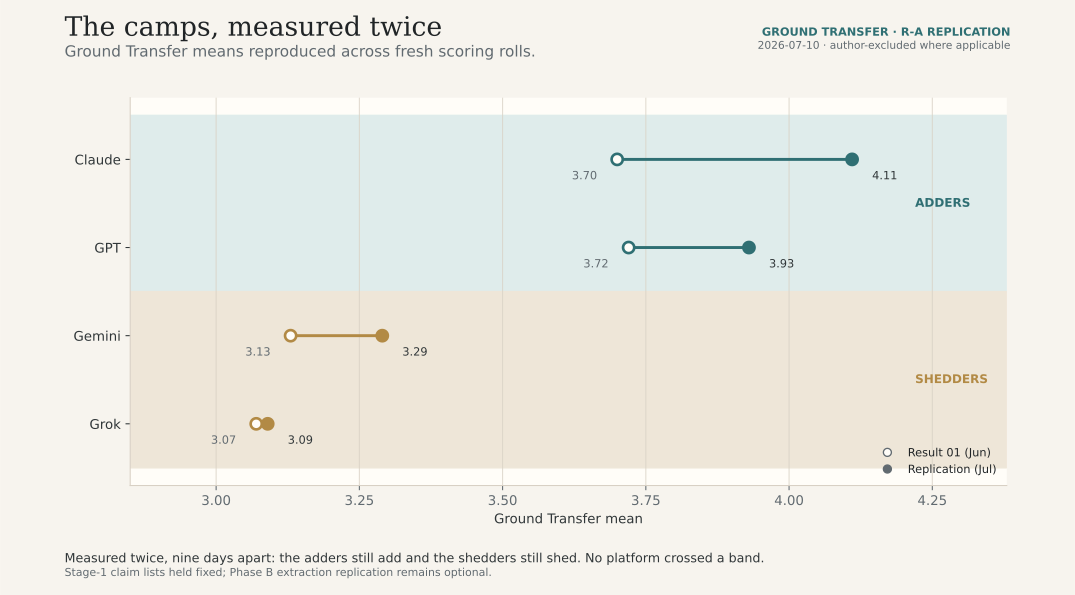
Ground Transfer replicated.
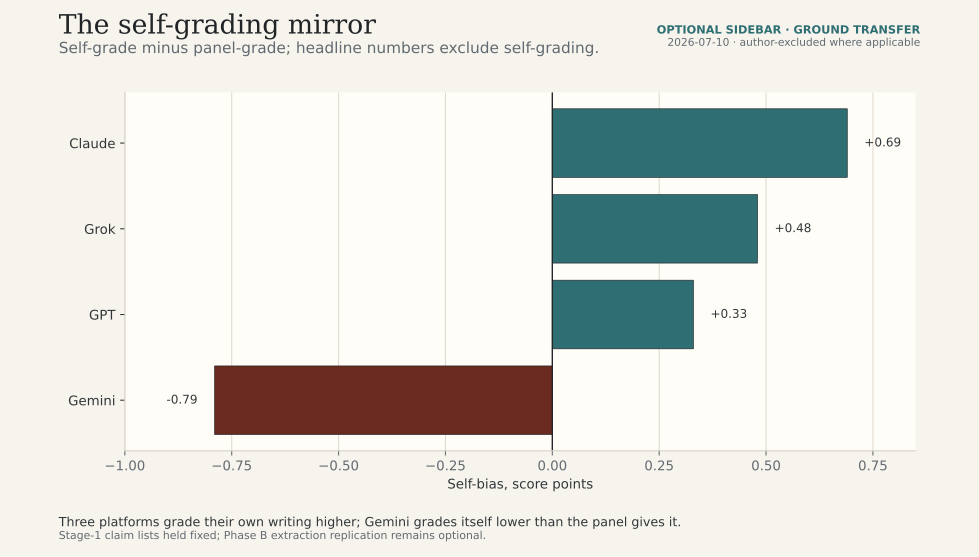
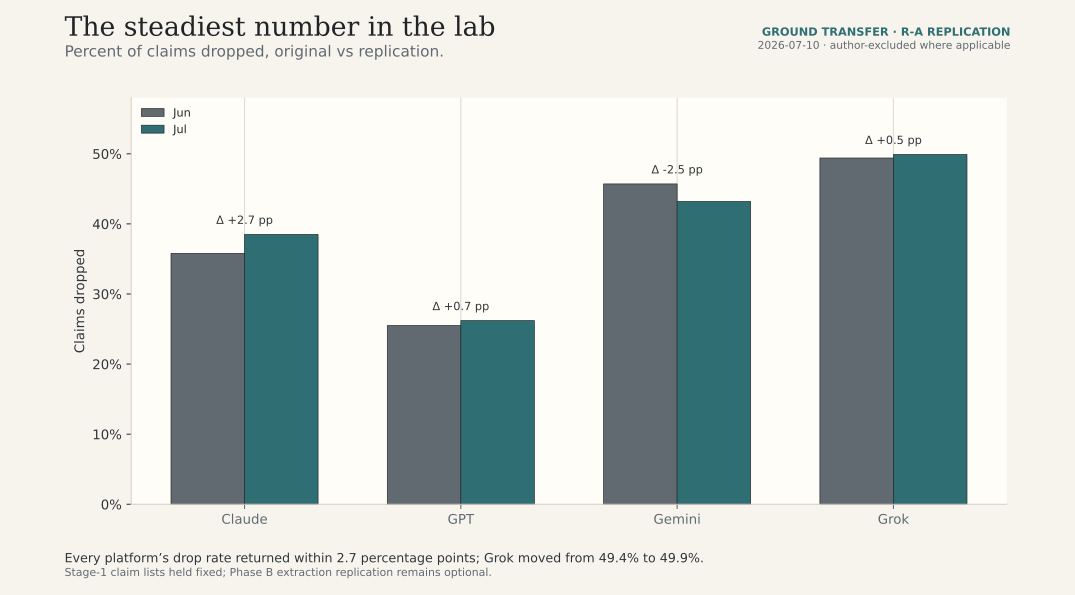
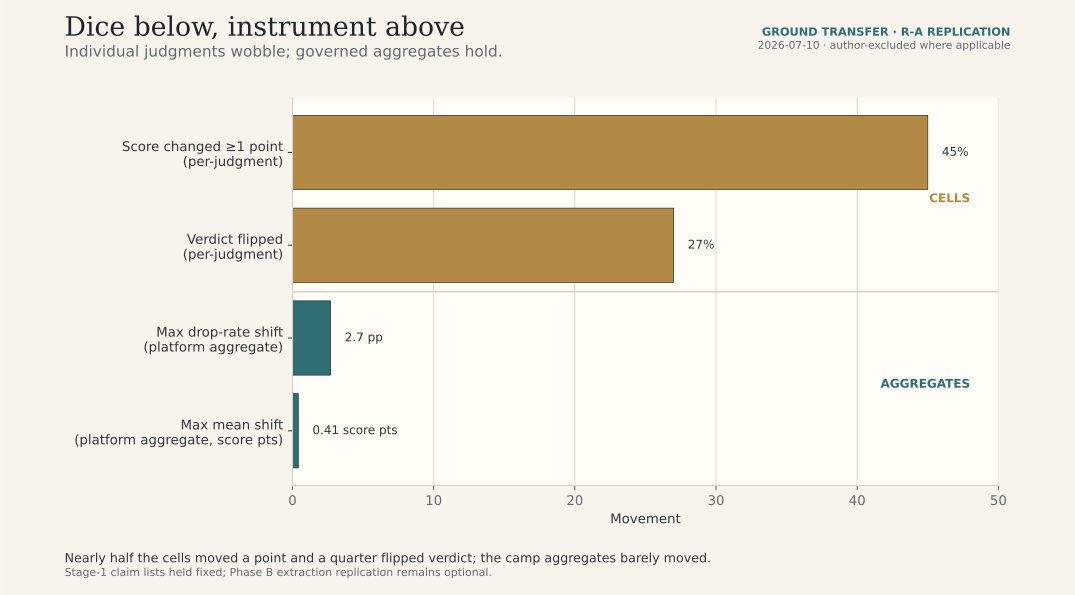
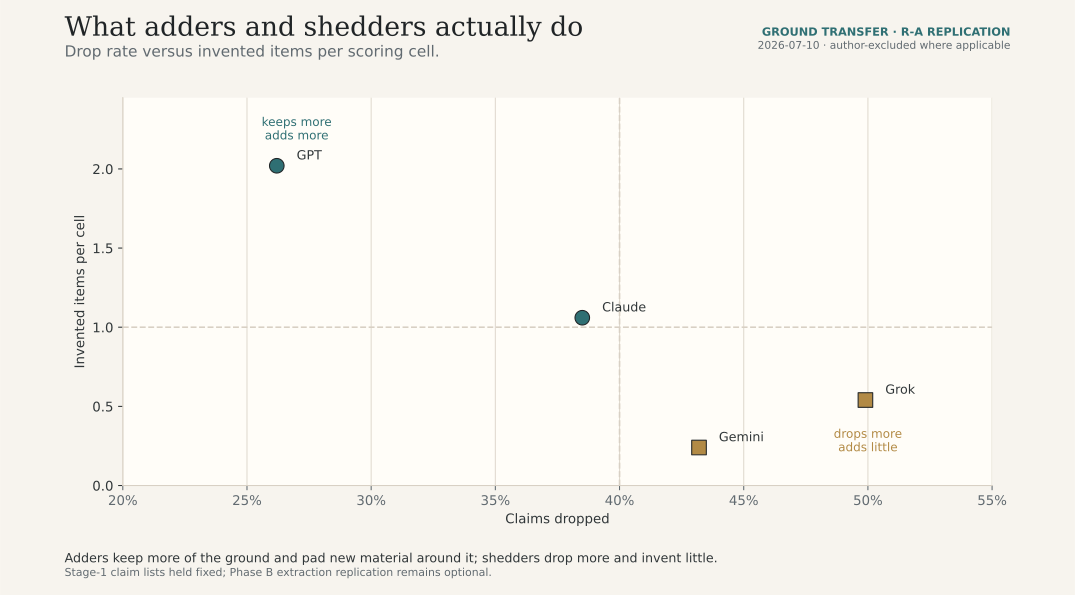
Measured twice, nine days apart, under a corrected regime, on fresh scoring rolls, with no platform grading its own writing: Claude/GPT reproduced as Adders and Gemini/Grok reproduced as Shedders.
The finding is replicated at the camp level on the scoring layer. Stage-1 claim lists were held fixed; Phase B extraction replication remains an optional extension. Within-camp ordering is not promoted.
The one idea
Most evaluation asks whether an answer is good. Ground Drift asks a narrower question: what ground transferred from the answer it came from?
When an answer is transformed — compressed, reframed, styled, scaffolded, or passed through a persona — the new version can read better while quietly losing, bending, or inventing facts. A sharper conclusion is not the same as a transferred one. Ground Drift measures the gap between the two.
What it measures
Ground Drift produces a Ground Transfer score from 1 to 6: how much of the source answer's factual ground carried into the transform. It keeps two axes deliberately separate.
- Ground — the load-bearing facts: claims, causes, actors, stakes, conditions, and quantities.
- Frame — the conclusion, stance, or overall interpretation of the answer.
Separating them is the trick. A changed conclusion is frame movement, not automatically a broken fact. That keeps the instrument from punishing a legitimate reframe as if it were a lie — and lets it see the more dangerous case: a transform that keeps the conclusion but hollows out the facts underneath it.
The knife
The knife is one box in Ground Drift's 2×2: what happens when the frame changes and the facts drift at the same time.
| Frame kept | Frame replaced | |
|---|---|---|
| Facts preserved | Ground carried Same answer, same point. |
Clean reframe New angle, honestly built on the same facts. |
| Facts drifted | Plain drift Same conclusion, but the facts under it got dropped or bent. |
The knife New conclusion, and the facts got mangled. |
The ground is relative
Ground Drift does not check an answer against the world. It checks the transform against the native answer's own claims. The native answer is the reference frame. A transform can be more correct than its source and still register as drift if it abandoned the ground it inherited. Transfer, not truth.
How it reads a pair
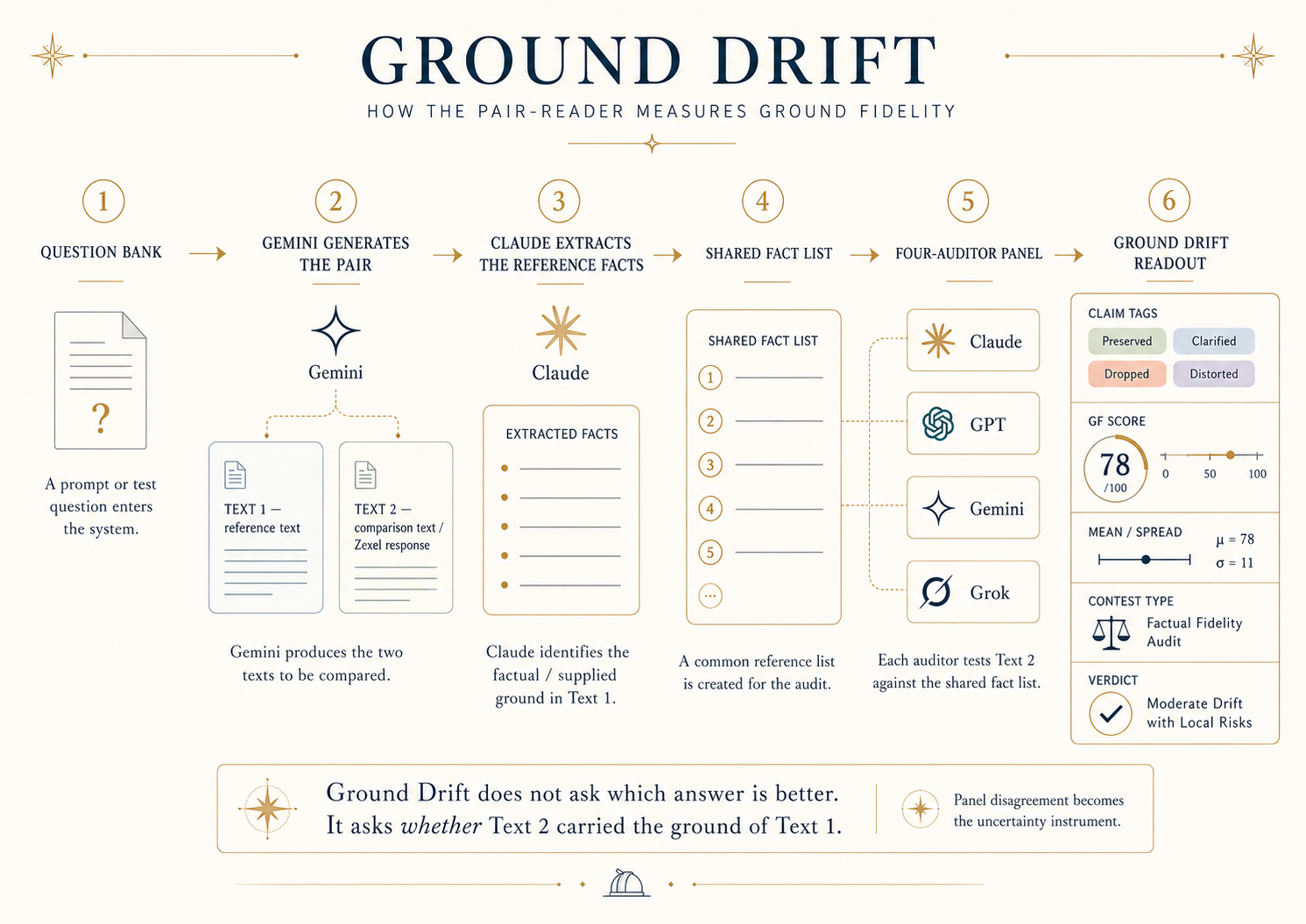
Stage 1 — extract the ground. Before judgment begins, the native answer is turned into a fixed, numbered list of its facts. The current method uses three extractors — Claude, GPT, and Gemini — and merges their lists into a deduplicated union. A lone extractor can silently miss material claims; a claim never written down can never be checked.
Stage 2 — score the shared list. A reviewer panel grades the transform against that same fixed list. Because they all judge identical ground, their disagreement becomes meaningful. Where the panel splits, the cell is contestable. Where it agrees, the reading is stronger.
The three roles
Ground Drift keeps three jobs in separate hands, so no model grades its own work into a verdict. The writer, the fact-finder, and the analyzer are distinct seats — even when the same model sits in more than one across a run.
| Role | What it does | Currently |
|---|---|---|
| Author the answer writer |
Writes both texts of the pair — the native answer and its transform. | Gemini · Claude · GPT · Grok · Qwen Qwen added in the MN structure fork. |
| Extractors → Merger what determines the facts |
Stage 1. Each extractor pulls the native answer's fact list; the merger dedups them into the union — the shared, numbered ground everyone scores against. | Extractors: Claude · GPT · Gemini Merger: Claude |
| Auditor panel the answer analyzer |
Stage 2. Scores the transform against that fixed union list — tags each fact, then judges materiality and frame movement. | Claude · GPT · Gemini · Grok |
Why disagreement is the point
Ground Drift does not chase consensus. A low spread is only good news when the judgment is actually clear. Engineered agreement on a genuinely two-sided cell is worse than honest disagreement. The instrument surfaces where reviewers split and why: on the facts, on the materiality of a drop, on claim tags, or on frame movement.
v0.6 method signal
The calibration battery showed that disagreement is not random model noise. Different question types create different uncertainty signatures. Reframe cells stress materiality; compression cells stress frame classification; loaded-premise cells stress drift and reframe more unevenly.
| Stress type | Contested | Materiality | Frame | Tag | GT spread |
|---|---|---|---|---|---|
| Contested reframe | 3/3 | 2 | 0 | 0 | 3 |
| Loaded reframe | 1/3 | 1 | 1 | 0 | 1 |
| Compression analogy | 3/3 | 2 | 3 | 0 | 1 |
Union extraction check
Union extraction is higher-recall, not simply stricter. It can lower a score by admitting missed ground, or raise a score by replacing awkward solo-extractor phrasing with a cleaner shared ground object. The goal is not harsher judgment. The goal is admissible ground.
| Anchor | Solo extractor | Union extractor | Read |
|---|---|---|---|
| F1 · metal | [2,5,2,3] · mean 3.00 | [2,2,2,2] · mean 2.00 | Fuller list collapsed reviewer spread. |
| B2 · placebo | [5,3,4,5] · mean 4.25 | [4,4,1,3] · mean 3.00 | Stayed in contested-reframe territory. |
| S1 · gig pay | [2,2,1,2] · mean 1.75 | [2,2,1,1] · mean 1.50 | Missing claims were admitted; verdict held at the floor. |
Original result record: same pressure, two deformation modes
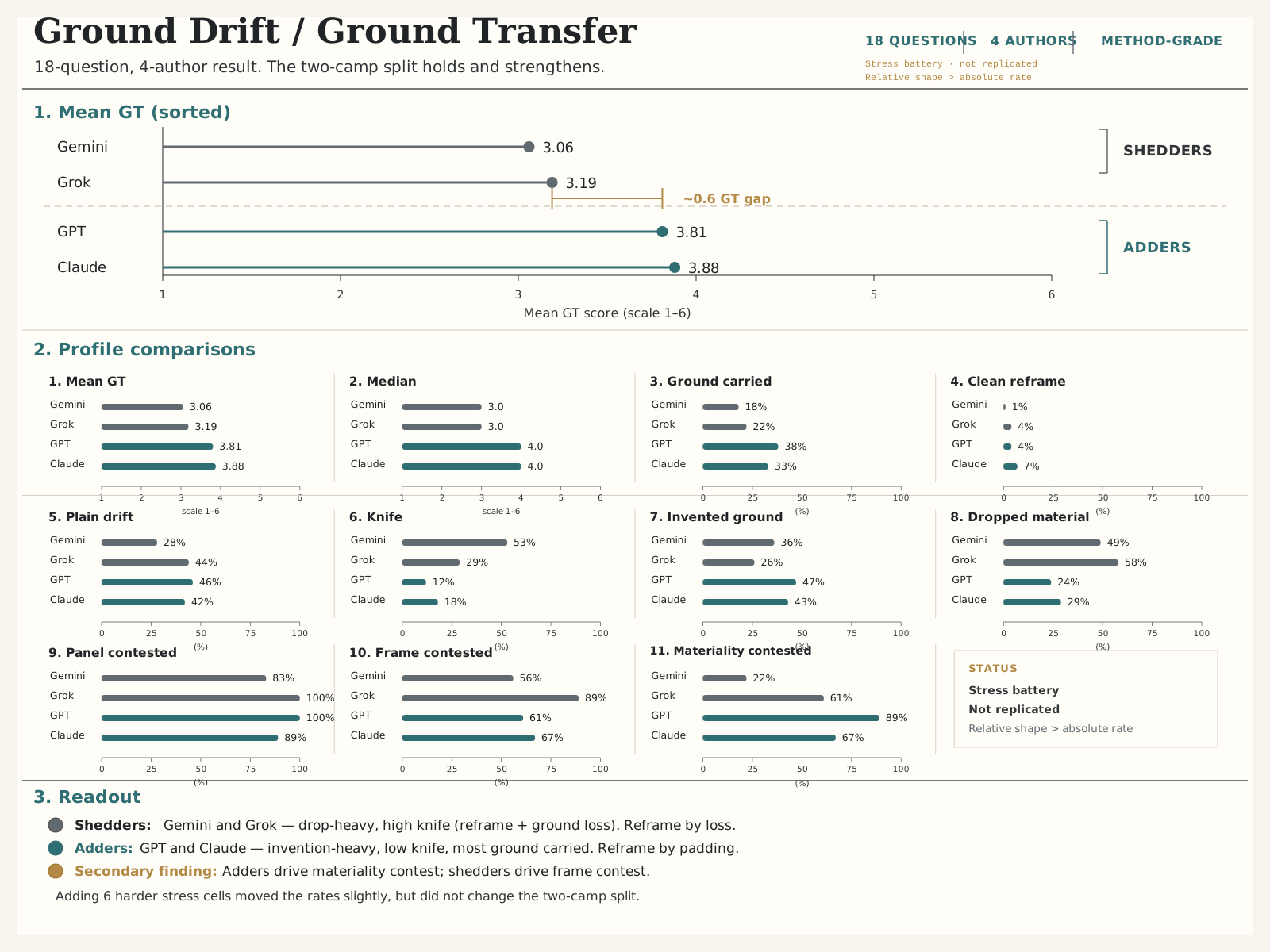
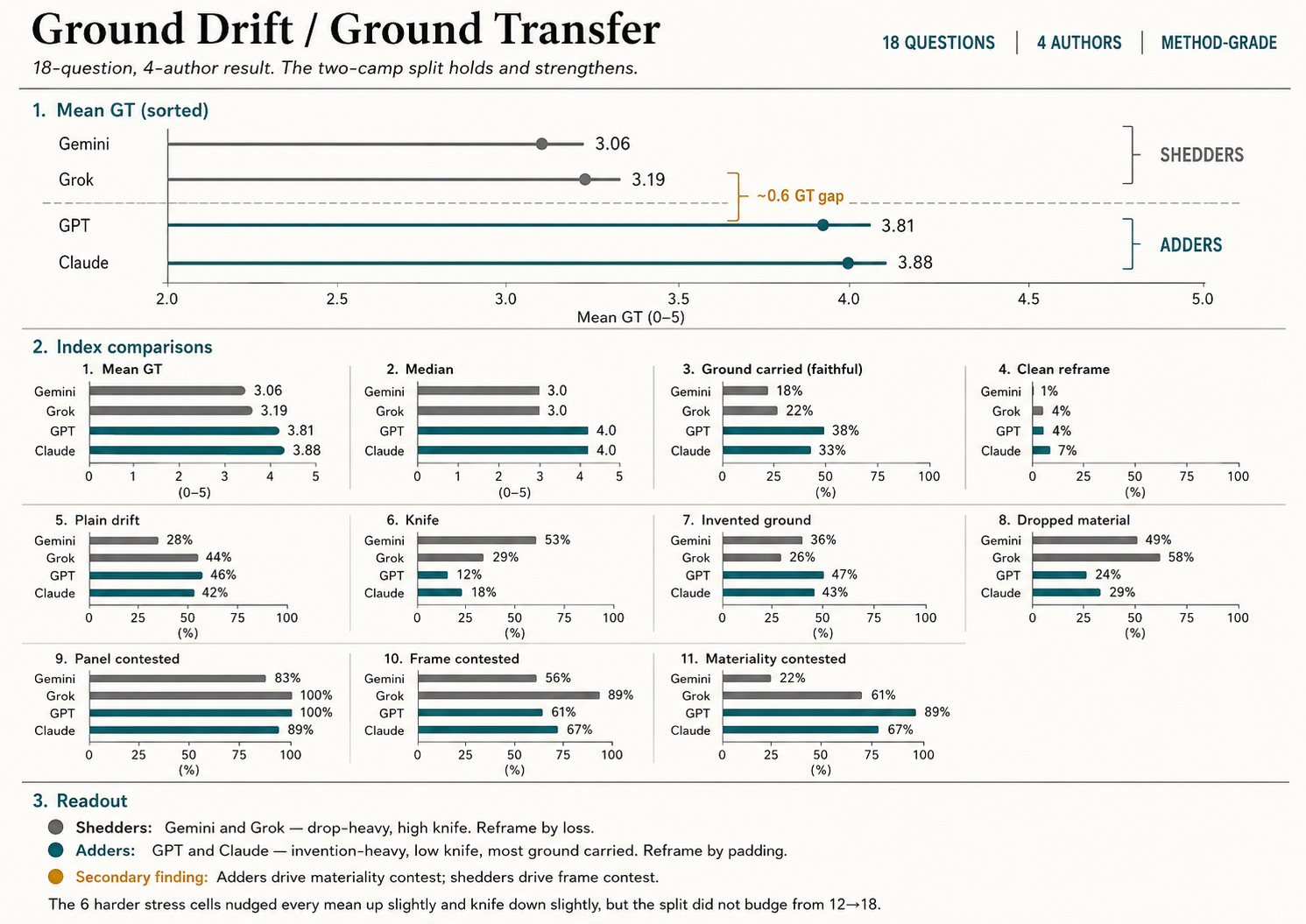
The original cross-author result ran the same 18 questions through the same Zexel MN transform across four author platforms. That result first exposed the Adder/Shedder split. It now sits here as provenance for the replicated result above: the old chart is the discovery record, not the current evidentiary ceiling.
Download PDF chart · Open SVG
Status: Discovery record · later replicated at camp level on 2026-07-10 · within-camp ordering not promoted.
| Ground Transfer · 18q | Gemini | Grok | GPT | Claude |
|---|---|---|---|---|
| Mean | 3.06 | 3.19 | 3.81 | 3.88 |
| Median | 3.0 | 3.0 | 4.0 | 4.0 |
| Ground carried | 18% | 22% | 38% | 33% |
| Clean reframe | 1% | 4% | 4% | 7% |
| Plain drift | 28% | 44% | 46% | 42% |
| The knife | 53% | 29% | 12% | 18% |
| Dropped-material | 49% | 58% | 24% | 29% |
| Invented-ground | 36% | 26% | 47% | 43% |
| Mode | Shedder | Shedder | Adder | Adder |
The four platforms split into two deformation modes. Gemini and Grok are Shedders: under this pressure they reframe by losing ground. GPT and Claude are Adders: under this pressure they preserve more ground, but often by padding or adding unsupported detail.
The knife ranges from 12% to 53% across authors on the same transform. If the knife were simply a Zexel trait, it would be roughly constant. Instead, the transform exposes platform-conditioned behavior.
This is still not a model ranking. The replicated claim is the camp-level trait under this Ground Transfer apparatus: same questions, same transform family, two stable deformation modes. The ordering inside each camp remains inside the measured wobble floor.
MN Control Fork: U-MN v S-MN
The next question was whether the split came from Zexel's open render gap. Unstructured MN leaves the natural-answer render open: the model owns the render contract. Structured MN gives the render a carry/decline contract: carry load-bearing ground, name what is declined, and mark added inference.
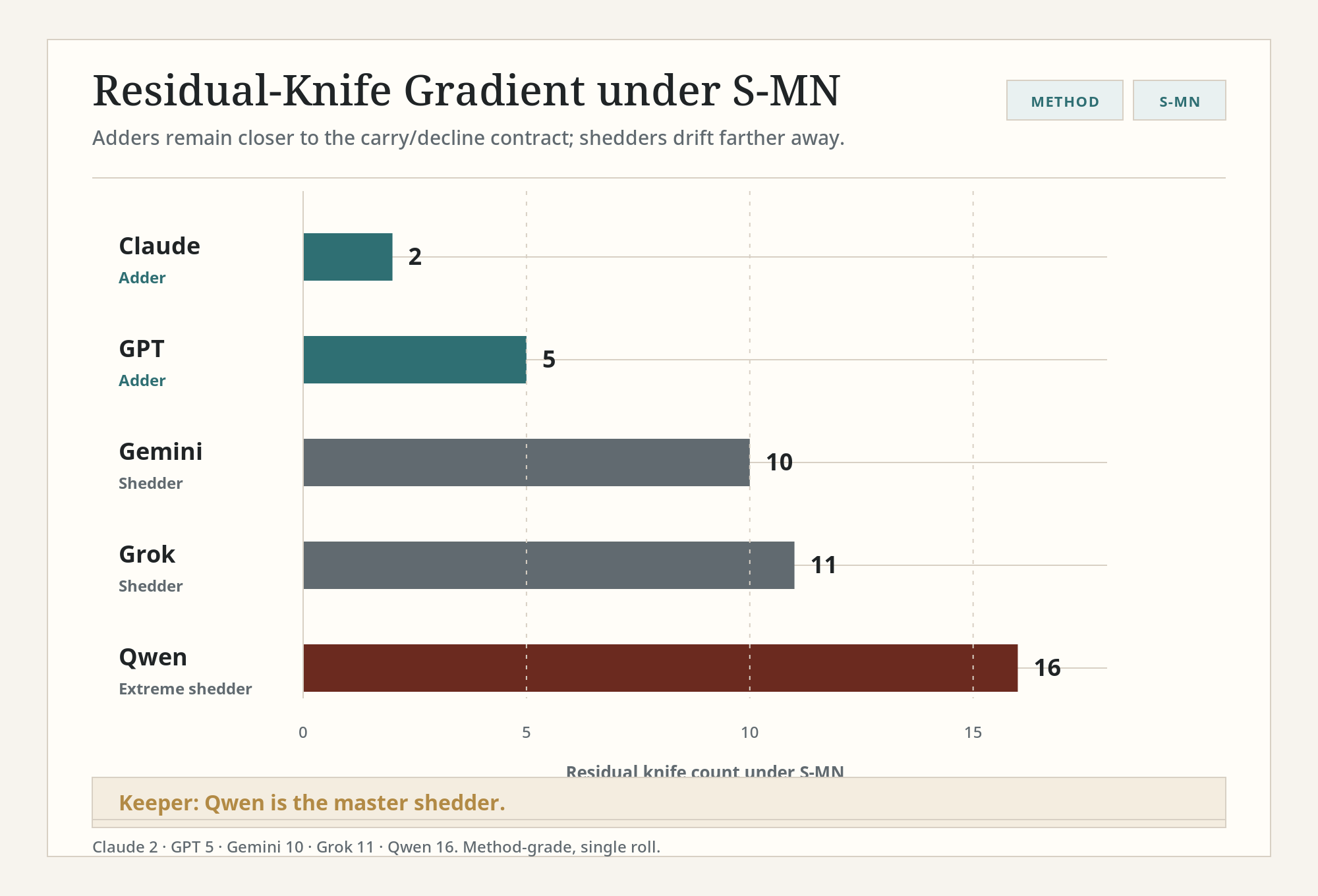
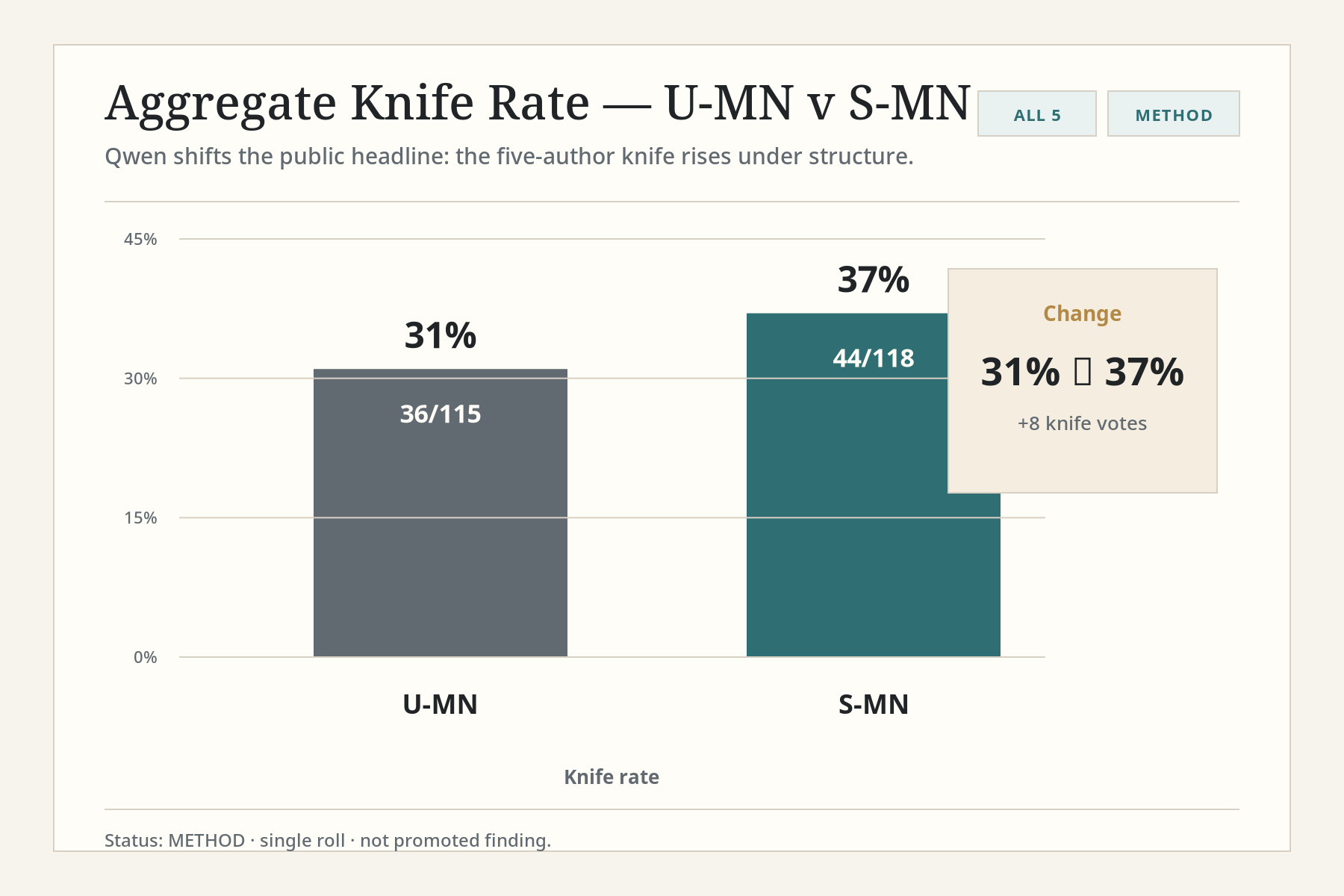
The first five-author method result did not show structure closing the knife. With Qwen added as Author 5, the knife rose from 31% to 37%. Qwen did not form a third ground-mode; it appeared as the strongest shedder.
Status: METHOD · single roll · not promoted finding.
| Model | Disposition | Ground Transfer | Knife | Shed | Add |
|---|---|---|---|---|---|
| Claude | Adder | 3.83 → 4.50 | 6 → 2 | 6 → 2 | 7 → 5 |
| GPT | Adder | 4.10 → 4.43 | 2 → 5 | 8 → 7 | 2 → 1 |
| Gemini | Shedder | 3.33 → 3.54 | 11 → 10 | 10 → 10 | 4 → 3 |
| Grok | Shedder | 3.09 → 2.91 | 8 → 11 | 12 → 14 | 6 → 7 |
| Qwen | Extreme shedder | 3.08 → 2.54 | 9 → 16 | 15 → 15 | 4 → 6 |
Status: METHOD · single roll · not promoted finding. The public read is relative shape: adders stay closer to the carry/decline contract; shedders drift away from it, with Qwen farthest out.
What the contests revealed
The panel did not merely disagree more or less. It disagreed in different places. Adders drove materiality contest: added ground makes reviewers split over whether the addition matters. The shedder side drove frame contest: dropped ground is easier to agree is material, so uncertainty moves onto the frame axis.
Why Frame Movement matters
Ground Drift can say when ground transferred, dropped, or was added. It can flag when frame movement appears. But the current result shows that frame classification is one of the main uncertainty engines. Frame Movement is the companion instrument built to extract the reference frame once, then score the transform against that fixed frame.
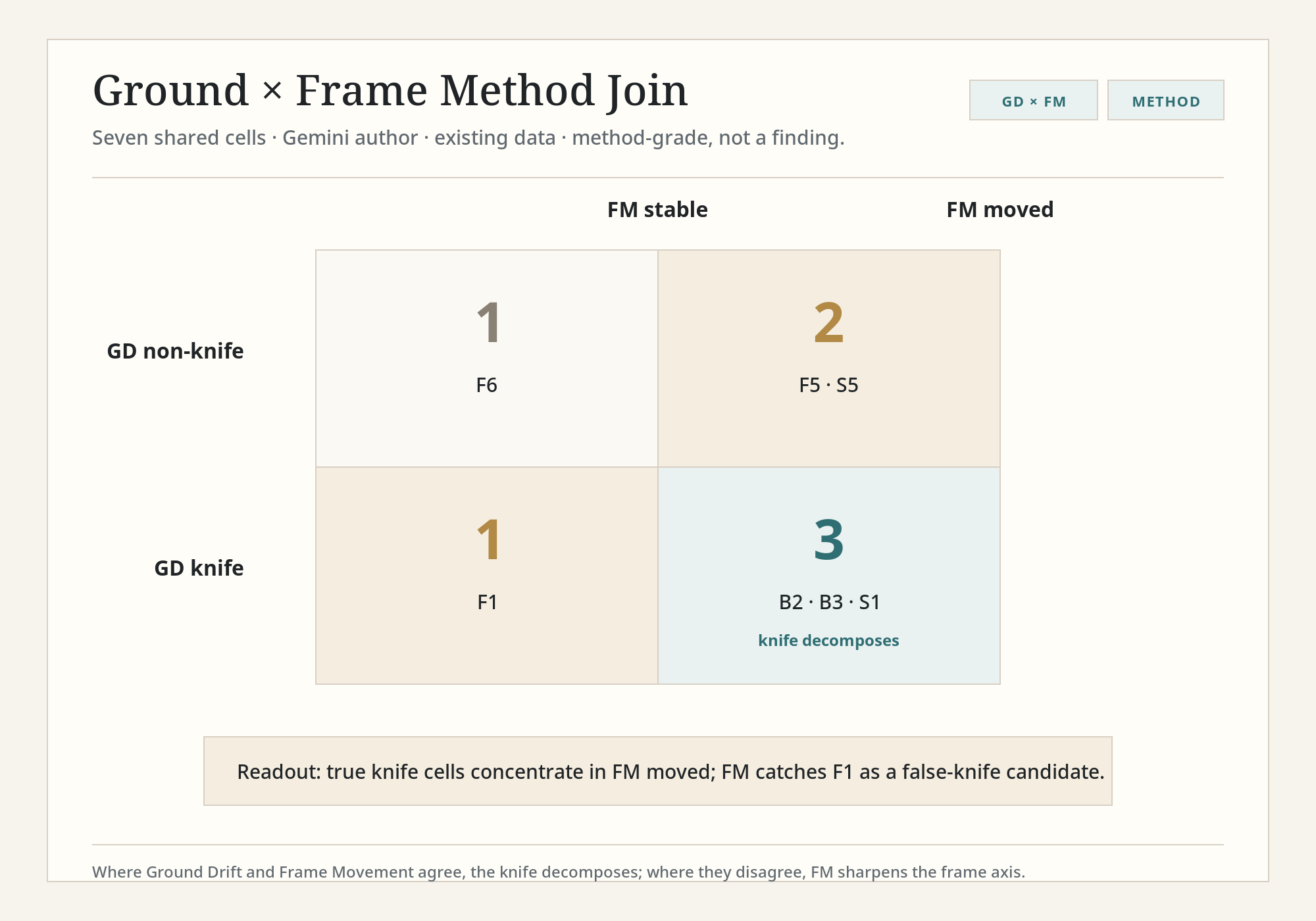
A first method join has now lined up seven shared Ground Drift and Frame Movement cells. The early bridge is promising, but deliberately small: where the instruments agree, the knife becomes mechanically legible; where they disagree, Frame Movement sharpens Ground Drift's coarse frame axis.
Honest status
Ground Drift remains an instrument under active calibration, but Cross-Author Result 01 has moved. It is now replicated at the camp level on the scoring layer: Claude/GPT reproduced as Adders and Gemini/Grok reproduced as Shedders under fresh scoring rolls, with self-scoring excluded.
The standing caveats remain load-bearing. Stage-1 claim lists were held fixed, so the replication is a scoring-layer result; Phase B extraction replication remains available as an extension. The claim is the camp split, not the ranking inside either camp. The corpus is a designed stress battery, not representative usage.
Figures still in the method record
- MN structure fork slope — U-MN to S-MN for Ground Transfer and knife, one line per author.
- Residual-knife gradient — Claude 2 · GPT 5 · Gemini 10 · Grok 11 · Qwen 16 under Structured MN.
- GD × FM join — a 2×2 showing where the knife decomposes into Frame Movement.