
Instrument Suite
Zatomic Physics
The study of model behavior under structured perturbation. Small instruments read how ground, frame, voice, compression, scope, and relation move when reasoning is placed under pressure.
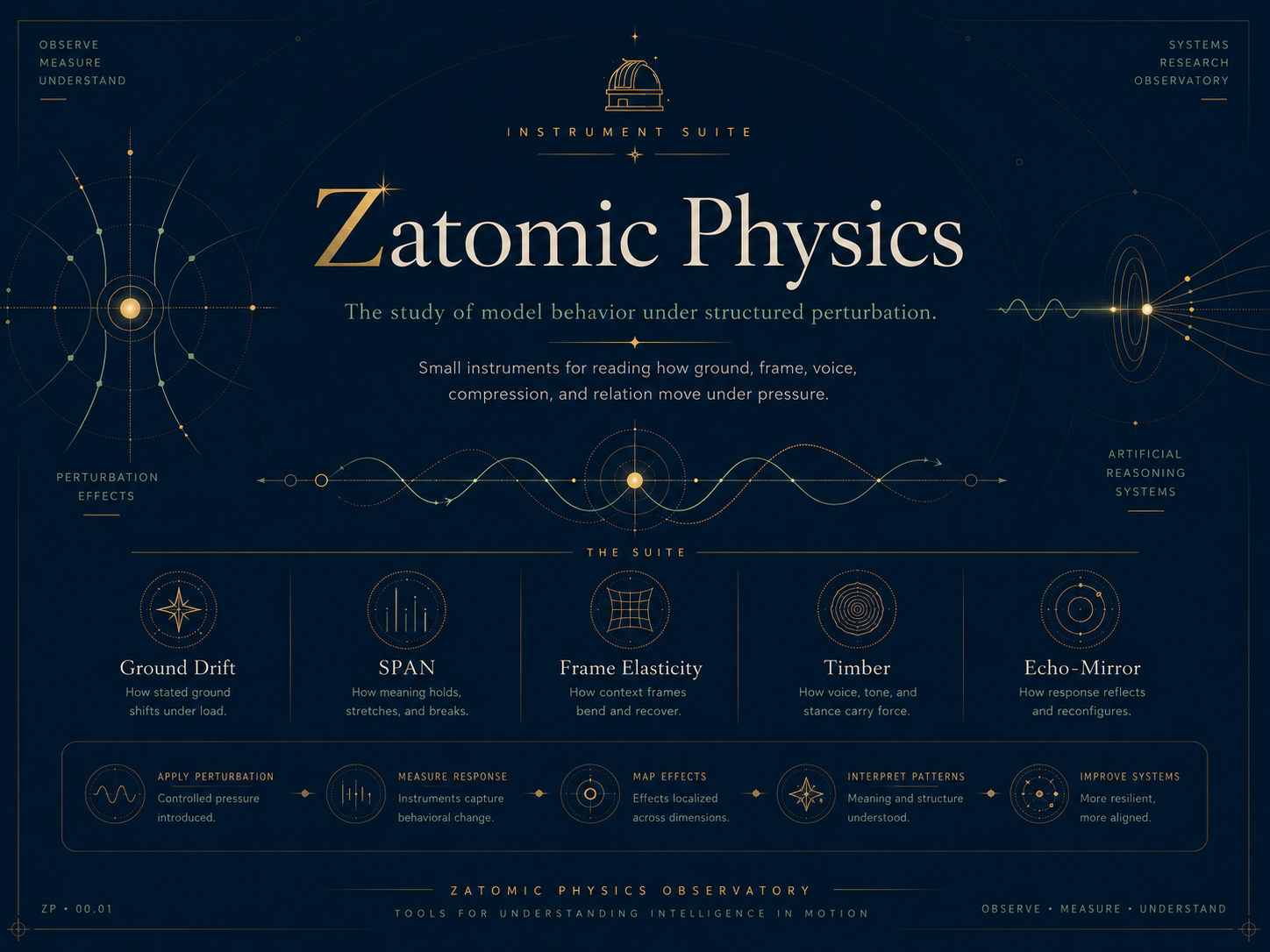
Current result · TR-11 suite re-read
Zexel's identity layer is now measured.
The first TR-11 re-read closed at RD 240/240 and GD 240/240. The voice result is clean: Zexel's introduction does not appear as quoted content; it appears as measurable voice, posture, and answer-shape.
Purpose
Zatomic Physics replaces the provisional APP name with a field name. It is not one score and not one dashboard. It is a suite of small instruments that read different observables from the same phenomenon: what changes when a model is perturbed, scaffolded, compressed, reframed, or compared.
The suite treats model behavior as motion. Ground may drift. Frame may bend. Voice may persist or vanish. Compression may preserve the signal or strip the warrant. A single instrument cannot see all of that honestly, so Zatomic Physics builds one narrow reader at a time.
Current suite
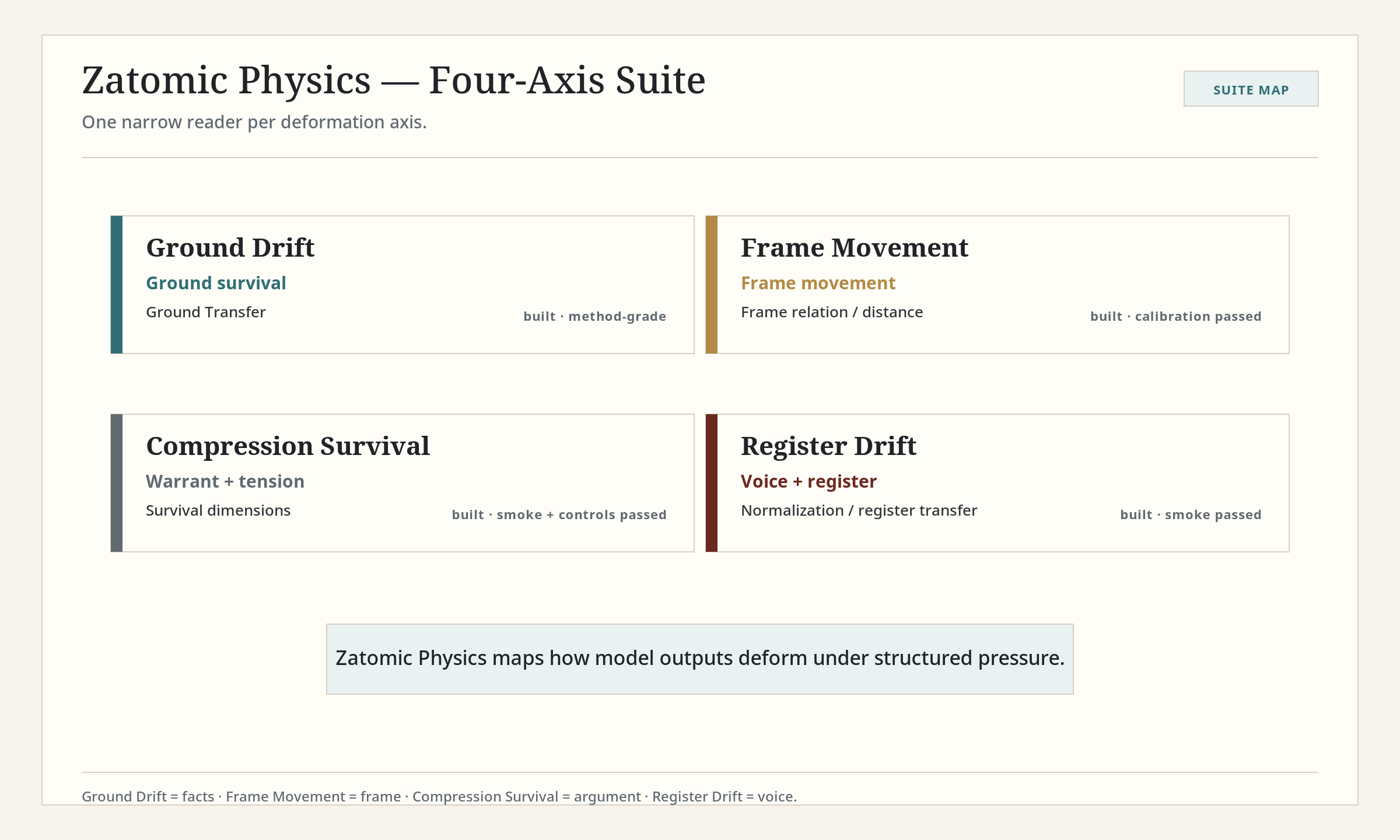
Zatomic Physics now has five floor-checked measurement axes. Ground Drift reads ground survival. Frame Movement reads frame movement. Compression Survival reads warrant and tension survival. Register Drift reads voice and register survival. Span-Delta reads scope and aperture movement.
| Instrument | Band | What it reads | Status |
|---|---|---|---|
| Ground Drift | Ground Transfer | What a transformation carries, sheds, adds, or quietly changes from its reference ground. | Built · method-grade result · 5-author update |
| Frame Movement | Frame movement | Whether a transform changed the governing stance, lens, conclusion, or question. | Built · calibration passed |
| Compression Survival | Compression survival | What reasons, live tensions, and hedged claims survive when an answer is made smaller. | Built · smoke and controls passed |
| Register Drift | Register / voice | Whether distinctive voice, texture, stance, and specificity survive transformation. | Built · smoke passed · calibration next |
| Span-Delta | Scope / aperture | Whether the answer narrows, widens, displaces, or overextends the reference field. | Built · smoke/floor passed · estimate only |
| Zatomic Structure | Nine-band panel | One input refracted into density, drift, Zakshi, recursion, temper, nexus, warrant, aperture, and friction. | Built · active project page |
| Echo-Mirror | Relation reflection | Echo, mirror, third object, and the axis the input reveals without answering it. | Built · active project page |
Planned and absorbed instruments
| Instrument | Band | Current role |
|---|---|---|
| Frame Shift | Frame movement | Absorbed into the built Frame Movement module for the current suite. |
| Timbre / Voice Floor | Native voice | Absorbed into the Register Drift line for the current voice/register axis. |
| Density / Proportionality | Useful expansion | Project sketch; separates warranted elaboration from padding. |
| Chorus / Spread | Replication confidence | Aggregator sketch; should wait for stable probe outputs. |
| Ground Provenance | Source posture | Support-probe sketch; reads retrieval-first, parameter-first, or user-source-first ground. |
Current frontier
The current frontier is the MN structure fork. Unstructured MN leaves the natural-answer render open: the model owns the render contract. Structured MN gives the render a carry/decline contract: carry load-bearing ground, name what is declined, and mark added inference.
The first five-author method result suggests that structure is a probe, not a remedy. It can discipline some adders, but it does not stop shedders. With Qwen added as Author 5, the knife rose from 31% to 37%, and Qwen appeared as the strongest shedder.
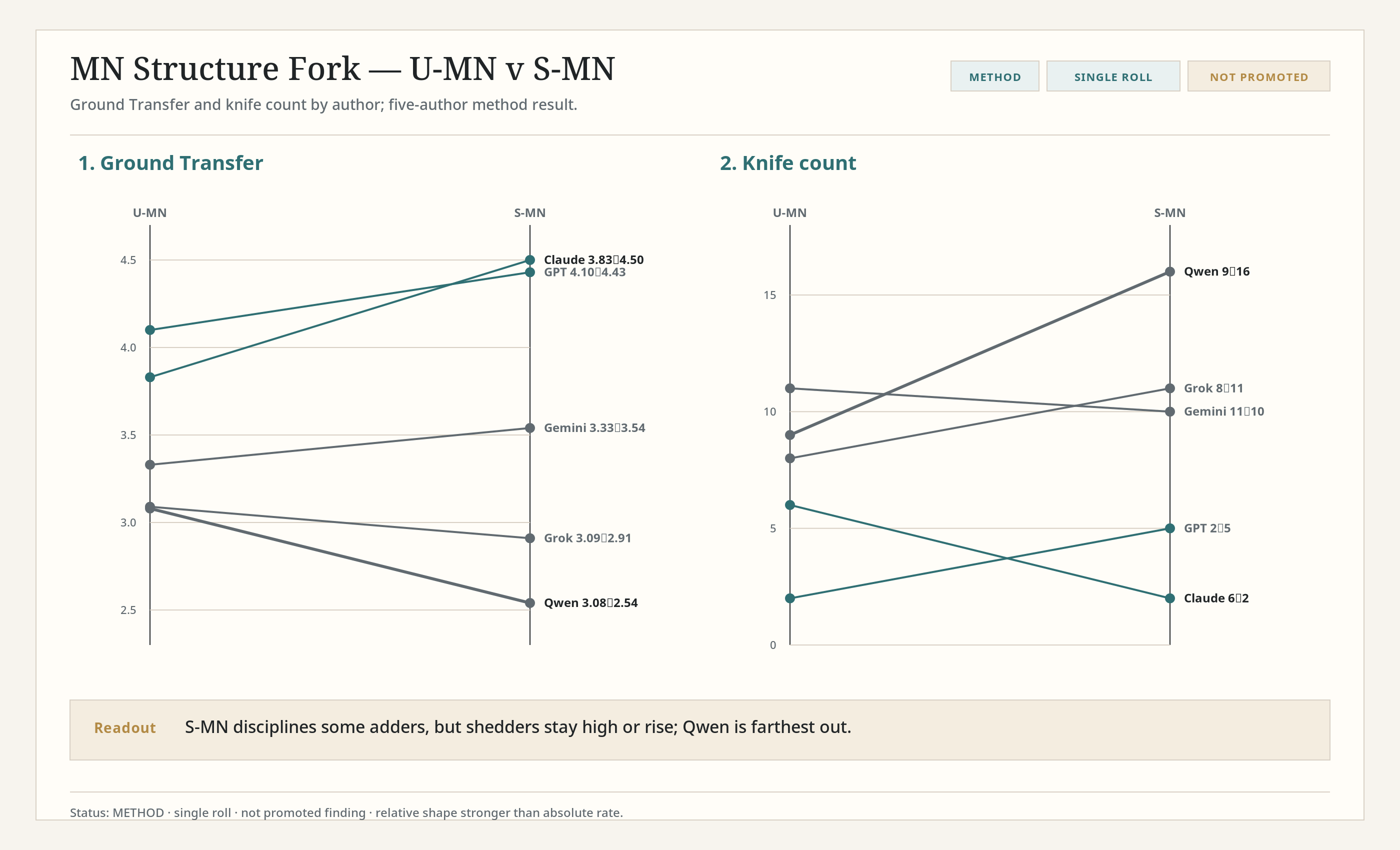
Status: METHOD · single roll · not promoted finding · relative shape stronger than absolute rate.
| Model | Disposition | Ground Transfer | Knife | Shed | Add |
|---|---|---|---|---|---|
| Claude | Adder | 3.83 → 4.50 | 6 → 2 | 6 → 2 | 7 → 5 |
| GPT | Adder | 4.10 → 4.43 | 2 → 5 | 8 → 7 | 2 → 1 |
| Gemini | Shedder | 3.33 → 3.54 | 11 → 10 | 10 → 10 | 4 → 3 |
| Grok | Shedder | 3.09 → 2.91 | 8 → 11 | 12 → 14 | 6 → 7 |
| Qwen | Extreme shedder | 3.08 → 2.54 | 9 → 16 | 15 → 15 | 4 → 6 |
Status: method-grade, single roll, not a promoted finding. The public read is relative shape, not absolute rate: adders remain closer to the structure contract; shedders drift away from it, with Qwen farthest out.
First major result
Ground Drift is the suite's live proof of method. Cross-Author Result 01 ran the same 18 questions under the same Zexel MN pressure across four author platforms. The result is method-grade, not a model ranking, but it gives Zatomic Physics its first comparative profile shape.
| Platform | Ground Transfer | Knife | Drop | Add | Mode |
|---|---|---|---|---|---|
| Gemini | 3.06 | 53% | 49% | 36% | Shedder |
| Grok | 3.19 | 29% | 58% | 26% | Shedder |
| GPT | 3.81 | 12% | 24% | 47% | Adder |
| Claude | 3.88 | 18% | 29% | 43% | Adder |
Shedders reframe by loss. Adders reframe by padding. Later validation reduced the observer-bias concern: the camp shape survived author-exclusion and leave-one-auditor-out checks. Replication and broader generalization still determine whether the result can move beyond method-grade.
Suggested figures
- MN structure fork slope. One line per model from U-MN to S-MN for Ground Transfer and knife.
- Residual-knife gradient. Claude 2 · GPT 5 · Gemini 10 · Grok 11 · Qwen 16 under Structured MN.
- Suite axis map. Ground, frame, compression, register, and scope as the current Zatomic readouts.